• Skip to main content
  • Skip to primary sidebar

Childrens Cove

The Cape & Islands Child Advocacy Center

  • Building Hope Capital Campaign
  • Get Help
  • Contact Us
  • Home
  • Child Abuse
    • What is Child Abuse?
    • Sexual Exploitation
    • Signs + Symptoms
    • If You Suspect Abuse
  • Parents + Caregivers
    • Have the Conversation
    • How to Protect Your Child
    • Keep Kids Safe ONLINE
    • Resources
    • Parent FAQs
  • Kids + Teens
    • Kids
    • Teens
  • Services
    • Accessing Services
    • Forensic Interview
    • Mental Health
    • Family Advocacy
    • Medical
    • CSEC
  • Community
    • Community News
    • Education
      • Professional Training
      • Community Education
      • Online Education
    • Volunteer
    • Upcoming Events
  • About Us
    • Our Story
    • What Are CACs?
    • Staff + Board
    • Employment + Internships
    • Media
      • Media Room
      • Brand + Campaigns
      • Press Releases
    • Contact Us
    • General FAQs

GET
HELP

QUICK
EXIT

Jacob Stapledon

Community Partner – Friends of Children’s Cove

December 10, 2025 by Jacob Stapledon

Filed Under: Homepage Featured News

Online Safety is Critical

December 9, 2025 by Jacob Stapledon

Filed Under: Homepage Featured News

How Sensationalism in Social Media Hurts Child Victims

October 17, 2025 by Jacob Stapledon

Back to Posts

How Sensationalism in Social Media Hurts Child Victims

Jacob Stapledon

October 17, 2025

In 2018, during a press tour for his movie “Eighth Grade,” comedian Bo Burnham made a statement that in the modern era, with no new land to colonize, corporations now seek to “colonize human attention” through social media. This concept of human attention has been explored and exploited by every means of media throughout every stage of technological evolution.

From the printing press to radio, early TV, the 24-hour news cycle, and now social media, the desire to attract and keep human attention has changed its methods and strategies. Factual and standard reporting is now often overlooked, while sensational headlines and extreme photos have become the standard. With these changing standards, the “adapt or die” mentality has found its way into every media company. Even once reputable and unbiased organizations have taken on this more extreme approach in reporting.

At the same time, a new phenomenon has come to the fore. The additional concept of “citizen journalists” has become a widely accepted and replicated format in the social media spheres, with unchecked reporting on “juicer” stories. Unfortunately, this includes cases involving child victims of crime, and in particular sexual abuse and exploitation. While we have discussed the media’s role in providing factual and trauma-informed reporting, the sensationalism of reporting on  cases involving children by social media content creators is an issue we need to bring to light.

The structure of social media platforms creates a recipe for disaster set against effective and trauma-informed reporting of these types of cases. Successful social media thrives only through engagement. Following an extreme or sensational title, there is no better place to understand the issues we’re describing than by checking the comment section. It is the place people regularly gravitate towards before they’ve completely read an article or finished a video, a forum most often awash with critical comments and vile attributions. Those who are consuming social media are actively looking for the summary, the argument, or an opportunity to join the argument without fully understanding the issue. Repugnant attributions to children being willing participants in clear cases of exploitation or assault are not uncommon in these spaces. This is called victim blaming, and it is dispensed in a callous and unfeeling manner with real consequences.

What is the long-term effect of too much information? One of the effects is the need to be first, not even to be true anymore.”

However, shutting off this proverbial free-for-all is something that can’t be done, without sacrificing the curated algorithms needed to get the post in front of people. While people clicking links and following to longer-form content helps, a frenzied comment section is what leads to increased exposure. As such, a controversial comment section is a busy comment section. This will not only attract the post to those who write these comments (often referred to as rage-baiting) but those who engage in the fiery defender response.

Adding insult to injury, when the algorithms which curate the content for users identify this is what people “want” to see through their engagement, they will be shown more of this type of content. Content will then (by the nature of the platform) need to become even more extreme to garner the same level of attention  earlier posts received. Viewers become desensitized to what they are seeing, hearing, and reading, and the minimization of the victim, – as a human being, as a child  – from the entire equation happens quickly.

This lack of empathy creates a culture of consumption, without question. The story is all too often presented with shocking headlines, controversial engagement, and the creation of conflict in public spaces. And as such, stories to engage and enrage the viewership are created with often nothing more than a headline, a few quotes of limited detail, a request for engagement, and posted in local community forums to let the games begin.

As Denzel Washington stated in a 2016 soundbite, “What is the long-term effect of too much information? One of the effects is the need to be first, not even to be true anymore.” Unfortunately, the rush to be first for reporting cases involving child sexual abuse and exploitation has taken priority over the important questions about what information is being reported, and whether it serves the public interest for safety.

Social media reporting on active cases of child sexual abuse often goes far beyond the scope of public’s need-to-know. This has included intimate details of sexual abuse and assault, children’s statements in police reports or court reporting, and the over-description of the relationship between alleged perpetrators and victims. We have seen cases where photographs of children who may have been victims in cases of family violence have been pulled from private social media accounts and rebroadcasted. What’s more, there have been instances where information included in reports went so far as to identify victims through association or unnecessary ancillary details.

The trickle-down effect of individuals with too much time, the desire for attention, and a social media account has created an unintentional secondary market in the revictimization of the defenseless. Our cultural fascination with the traumatization of others has caused the over-exposure of a victim’s experience and reduces the chances for a victim to be empowered when they are placed under a microscope. When other survivors, who have not yet had the opportunity to step forward to ask for help, see this, read the vitriol in the comments, and see the exposure of private and traumatic experiences as the casual hobby of others – they will not step forward.

Additionally, when the reporting of child sexual abuse and other crimes against children only focuses on the most heinous crimes with the most vulgar descriptions of victimization, it minimizes the experiences of others. The comparison of victimization creates a culture by which those who, in their own experiences, have been a victim of an individual or repeated instance of crime may believe that they are not worthy of help and support. Or, and to a certain degree, worse – they may have their experience shrugged off as others compare their stories to those they have seen in social or news media.

Being a victim of abuse is a subjective trauma – no one can understand the feelings or emotions but the victim. Without a shift to empathy, support, and understanding, we will continue to have a culture where victims of child sexual abuse and assault rarely disclose their abuse.

If we are going to work together to mitigate the stigma of child abuse, create a world where children have voices which are heard, we need to all do our part in toning down the sensationalism we see every day.

At Children’s Cove we want to ensure the facts and information related to child sexual abuse and other crimes against children are brought to the forefront with compassion and care. If you would like to learn more about ways to report or discuss sensitive topics  in a trauma-informed fashion, or receive an educational program at no cost,  please reach out to Jacob Stapledon, Community Engagement and Education Program Manager by emailing him at jacob.stapledon@childrenscove.org 
Join our mailing list.

Sign Up Now

Filed Under: OUR TAKE

Community Partner Spotlight: MACA

October 17, 2025 by Jacob Stapledon

Back to Posts

Community Partner Spotlight: Massachusetts Children’s Alliance

Jacob Stapledon

October 17th, 2025

As the Cape & Islands Child Advocacy Center (CAC), Children’s Cove is on the front line of the coordinated response to cases involving crimes against children in the region. We provide a compassionate, efficient, child-friendly facility for child abuse intervention, and our staff facilitate a streamlined process which reduces the risk of retraumatization for children and preserves the best evidence for investigators. With more than 950 CACs in the country, we are not alone in that effort. While Children’s Cove is the only agency of its kind that serves the Cape & Islands, we are but one of 12 in the Commonwealth of Massachusetts, where we work collaboratively to advance awareness and action on the critical issues impacting children.  Together, our work receives coordinated communication and support from our state chapter, the Massachusetts Children’s Alliance (MACA).

Founded in 1996, MACA has become the local, state, and national go-to resource for helping victims of child abuse through the statewide network of CACs. A nonprofit organization based in Boston, MACA’s mission is to pioneer the most promising, up to date practices and techniques to help victims of child abuse. They do this by delivering effective educational programming, galvanizing informed and committed legislative support, and mobilizing communities to have tough but necessary conversations about child abuse. As the state chapter, MACA focuses on critical areas of need, which often fall outside the direct service delivery provided by individual CACs, in addition to providing assistance with the development and enhancement of member centers (like Children’s Cove).

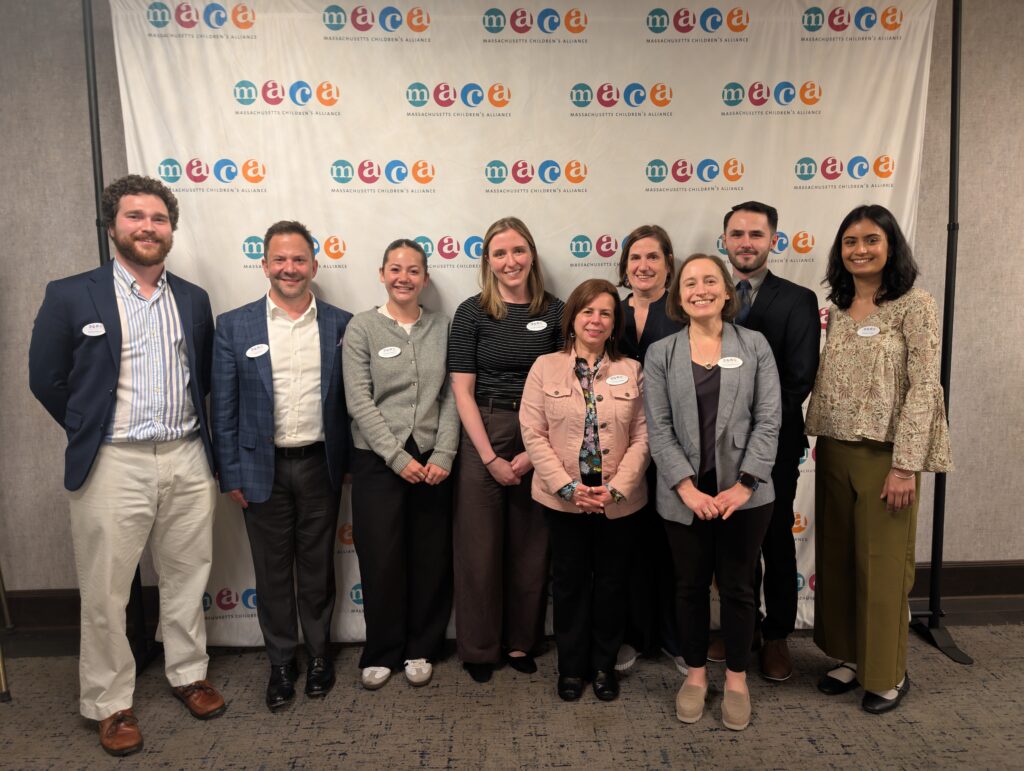
The MACA Team at their 2025 Healing, Hope & Justice: An Advanced Conversation Conference

While there are numerous ways MACA supports CACs in the Commonwealth, the direct impact on the Cape & Islands is palpable. For many years, MACA spearheaded efforts and worked with state legislators to codify stable funding for CACs across the Commonwealth, and, in 2022, was able to secure $200,000 in funding for staff positions at Children’s Cove. They have provided funding and support to Children’s Cove through grant application and management assistance to build regional capacity in the areas of education and training for our multidisciplinary and behavioral health providers. Most recently, this was evidenced by nearly $75,000 in funding received from the Tower Foundation to provide practitioner training in the evidence-based clinical treatment called Child and Family Traumatic Stress Intervention (CFTSI) for local mental health clinicians who take referrals from our center. MACA supports training for CAC staff and local providers through their access to mental health initiative. This includes organizing trainings in CFTSI, TF-CBT, telehealth, and treatment for children and youth with problematic sexual behavior (PSB-CBT).

Coordinated communication is critical to the success of the 12 CAC’s across the state. MACA facilitates a network of meetings internally to support the various disciplines that make up a CAC team. Throughout the year, CACs meet remotely to discuss current trends and peer feedback in forensic interviewing, mental health and treatment modalities, education, awareness, and training initiatives. These conversations allow us to move forward together in the care of children. To further reinforce this collaboration, each year MACA hosts their annual conference Healing, Hope & Justice: An Advanced Conversation bringing together more than 300 child abuse professionals from across the Commonwealth. Attendees include law enforcement, prosecutors, Department of Children and Families (DCF) investigators, medical and mental health professionals, and Children’s Advocacy Center (CAC) staff, all dedicated to improving responses to child abuse.

We are honored to work with the incredible team at MACA, who have long partnered with us to support critical services in our region and meet the needs of the children we serve. Thank you!

To learn more about the Massachusetts Children’s Alliance, visit their website here.

Join our mailing list.

Sign Up Now

Filed Under: COMMUNITY

When Online Safety Hits Home

August 16, 2025 by Jacob Stapledon

Back to Posts

When Online Safety Hits Home

Jacob Stapledon

August 16, 2025

If you are a parent or caregiver of a child who plays games online, you have probably heard the word Roblox at least a few times. And, if you pay attention to what is happening in online spaces you may have heard that word a few more times in recent weeks, with some concerning language attached to it. We don’t usually weigh in on online hotspots, but this issue hits close to home. It connects directly to work we’ve done in our community in recent months and highlights risks and concerns you should know about.

As a starting point, Roblox is an online platform and game creation system that allows users to create, share, and play millions of games. It’s a virtual universe where users, for the most part children and teens, can interact on platform with over 100 million monthly users. With the exception of in-game payments for various items, the game itself is free for users to play on any gaming system or smartphone, which increases access significantly and helps generate its younger user base. However, this free to play, open access, generative environment is what essentially opens it to being a virtual “wild west.”

Roblox has been facing significant backlash and legal challenges in recent months, primarily centered on child safety issues and the company’s moderation policies. A key theme in these controversies is the allegation that Roblox has prioritized user growth and profits over the safety of its young users. The most serious and pressing concern is the alleged failure of Roblox to protect children from predators. Multiple lawsuits have been filed, including one by the Attorney General of Louisiana and another by a Texas man, alleging the platform’s design and weak moderation have created an environment where child predators can “thrive, unite, hunt, and victimize kids.”

Some of these lawsuits are based on specific cases of exploitation as well as citing a general environment of allowing exploitation to take place. These include:

  • A lawsuit in Iowa claims a 13-year-old girl was introduced to a predator on the platform who later kidnapped and sexually assaulted her.
  • A Texas man is suing the company, alleging he was groomed and sexually abused as a child by a contracted Roblox developer he met on the platform. The lawsuit claims Roblox was unresponsive to his mother’s pleas for help.
  • The lawsuit filed by Louisiana’s Attorney General alleges that despite having a “zero-tolerance policy for the exploitation of minors,” Roblox’s lack of effective age verification and safety protocols puts children at risk.

These lawsuits have a common thread: the company has failed to put effective age checks in place to keep children safe. The court actions also show that Roblox’s content and user moderation is weak at best, allowing sexual and violent material to spread across the platform.

One video highlights the creation of a brand new Roblox  account – where in less than 15 seconds the user was engaged with inappropriate content.”

Within the gaming and online community itself there has been a significant social media campaign against Roblox as the company has recently retaliated against users who have highlighted the issue or worked with law enforcement and other organizations to stop online predators on the platform.

One particular user and YouTuber known as “Schelp” with more than 800k subscribers has been one of the most vocal of the issue, posting a video in which he pretends to be a younger child to highlight the issue of predators on the platform. As a result of this action his account was banned, which has contributed to actions taken against the company.

Another user, known as “KreekCraft”, with more than 13 million subscribers on YouTube, generated two videos recently.  One video highlights the creation of a brand new Roblox  account – where in less than 15 seconds the user was engaged with inappropriate content. Another  longform video highlights the recent issues involving the wider Roblox community.

So, what should you know about this, and where does this hit home? As we discussed in our April Newsletter, we had the pleasure of meeting with students from 3rd to 8th grade in Mashpee and Monomoy school districts to talk about online safety, digital mindfulness and gaming.  . During the sessions with Richard Guerry from IROC2 , more than half of the 1,400 students we engaged with acknowledged that they played games online. Most of them identified Roblox as the game they played the most, and more than half revealed they communicated with people online.

The risks to children in our community being targeted by predators online is very real. We urge parents to get, and stay, involved in their children’s online lives to observe and understand the overall content on these platforms. The “built-in” safeguards for these games, and others, aren’t enough. Teach your children that communication in games should only be in the game, about the game. Often predators build trust with children on Roblox and then try to move the conversation to less-moderated platforms like Discord or Snapchat. Reinforce that they should never accept invitations to talk off the game platform.

Please,  Take the Pledge and adopt an active role to prevent the sexual exploitation of children. Be smart and be safe online. It’s up to you to prevent online sexual exploitation of children.

Join our mailing list.

Sign Up Now

Filed Under: OUR TAKE

Sending Children Back to School Safely

August 16, 2025 by Jacob Stapledon

Back to Posts

Sending Children Back to School Safely

Jacob Stapledon

August 16, 2025

Back to school shopping is underway, school and bus schedules are coming together, figuring out sports and after-school activities is an extra jigsaw puzzle thrown into the mix. The rush to squeeze out every last ounce of summer is here. However, somewhere in the middle of it all we hope you can take the time to look at what conversations about safety in the new school year could look like. We want to provide you with some suggestions for how you can engage your child, and their school, in these important conversations.

School Safety Guidelines

Do you know the child abuse prevention policies in your child’s school? How does the school focus on prevention? Do they incorporate safety into their hiring process? Are staff provided with training on prevention and recognizing signs of abuse and how to report it? Do they regularly evaluate if their building has a safe environment which minimizes opportunities where students are not able to be seen? If you don’t know the answer to one, or any of these questions, please inquire with your child’s school administration. Talk with your child about talking with you if they have any situation happens at school where they don’t feel safe.

Technology

Schools and technology now operate hand in hand, even at the elementary school level. While schools have installed online safeguards for children, there are many ways to navigate around such precautions.  Children may find themselves in a situation they did not intend or fully understand. Talk with your child’s school about what safeguards are in place, and how online safety is discussed in school. Talk to your children about online safety, and the risks which exist, even on games and social apps.

Three Trusted Adults

Talk with your children about identifying three trusted adults who are in their lives, other than parents and caregivers. Explain that these three adults would be someone who they would go to if something happened if they felt unsafe, embarrassed, or unsure of what to do. This gives children the reassurance that they can ask for help outside of their immediate family. It also tells you, as a parent, who the important adults in their lives are..Get to know their names and take advantage of parent-teacher nights and socials to meet these individuals, and show you are an engaged and informed parent.

Consent

Talking with children about consent is something which should begin early and repeated often. Not only about sex, but about being hugged, touched, sharing toys or food, or sharing information. Remind your children that they are in charge of their bodies and choices, and no one should pressure them to do something they don’t want to do. This extends to relationships with peers, teachers, and other adults in their school. If we can communicate this with children earlier, later it will be an easier conversation about dating, online safety and sex.

Have Conversations Without Judgment

It is important for children and teens to know that if they make a mistake, they can have a calm non-judgmental conversation with their parents and ask for help. Children need to know their parents will always believe in them, advocate for them, and put their health and safety first. Ongoing and regular conversations about safety with kids and teens will help them feel supported, can provide reassurance, and increase their likelihood of asking for help.

These are just some of the ways you can talk with children and teens about safety as they return to school. If you would like to learn more, please email our Community Programs Coordinator Heidi Friedel at heidi.friedel@childrenscove.org. If you would like to learn more about online safety, please email our Child Exploitation Program Coordinator Anna Colby at anna.colby@childrenscove.org.

Join our mailing list.

Sign Up Now

Filed Under: COMMUNITY

  • « Go to Previous Page
  • Page 1
  • Page 2
  • Page 3
  • Page 4
  • Interim pages omitted …
  • Page 16
  • Go to Next Page »

Primary Sidebar

Children's Cove is a proud
department of Barnstable County.

Our Partners

Children's Cove - The Cape and Islands Child Advocacy Center ©2025. All Rights Reserved.
Individuals pictured are models and are used for illustrative purposes only. Children’s Cove is partially supported by the Massachusetts Office of Victims of Assistance through a Victim of Crime Act of 1984 (VOCA) grant from the Office of Victims of Crime, Office of Justice Programs, U.S. Department of Justice. In accordance with Federal law and U.S. Department of Agriculture policy, this institution is prohibited from discriminating on the basis of race, color, national origin, religion, gender or gender identity, disability, ancestry, age, marital status, public assistance status, sexual orientation, veteran history/military status or genetic information. (Not all prohibited bases apply to all programs.) To file a complaint of discrimination, write to USDA, Director, Office of Civil Rights, 1400 Independence Avenue, S.W., Washington, D.C. 20250-9410, or call (800) 795-3272 (voice) or (202) 720-6382 (TDD). USDA is an equal opportunity provider employer, and lender.

Privacy Policy
Terms of Use
Contact Us
Social Media Policy
Disclosure Notice
Volunteer
Communication Policy
Google Translate Disclaimer
ADA Grievance Procedure
ADA Reasonable Accommodation Policy

Copyright © 2026 · childrenscove child theme on Genesis Framework · WordPress · Log in